.webp)






Introduction
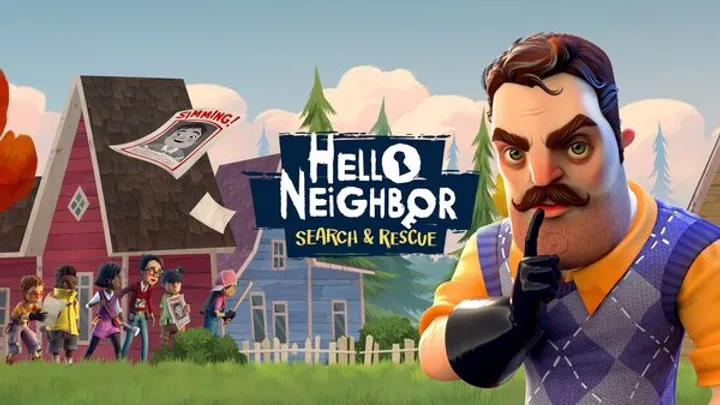
Hello Neighbor stands apart from many stealth horror games because the central challenge is not simply avoiding an enemy with scripted patrols. Instead, the Neighbor is designed around an adaptive artificial intelligence system that reacts to how players behave. Although the practical limits of the AI are often misunderstood, the underlying concept fundamentally changes the player's relationship with exploration, experimentation, and problem solving. Every failed attempt has the potential to influence future encounters, making the game feel less predictable than traditional stealth experiences.
Rather than focusing on jump scares or combat, Hello Neighbor creates tension through uncertainty. Players cannot always rely on repeating the same successful strategy because the Neighbor gradually responds to common behaviors. This article explores the evolution of the adaptive AI system from the first encounter to the late stages of the game, explaining how the Neighbor's learning mechanics influence player decisions, puzzle solving, exploration, and long-term strategy.
The First Encounter Introducing an Unpredictable Opponent
The opening moments establish an important expectation. Instead of presenting a fixed enemy route, the game introduces an opponent who appears to move dynamically throughout the house and surrounding property. Players immediately recognize that simply memorizing patrol patterns may not be enough.
This uncertainty creates psychological tension before any chase begins. Even when the Neighbor is not visible, players remain cautious because they cannot confidently predict where he will appear next.
Why unpredictability matters
An unpredictable opponent encourages observation rather than memorization. Players become more attentive to sounds, opened doors, broken windows, and environmental clues that reveal the Neighbor's current position.
Early Exploration The AI Begins Observing Player Habits
As players repeatedly enter the property, common behavioral patterns begin to emerge. Many players naturally choose the same windows, climb identical objects, or approach the house using familiar routes because those paths initially seem safest.
The adaptive system attempts to discourage excessive repetition by increasing the likelihood that the Neighbor will monitor frequently used locations. Whether through altered patrols or environmental responses, the game rewards experimentation over routine.
Learning through repeated failure
Every failed attempt provides information for both the player and the AI. The player gains knowledge about puzzles, while the Neighbor becomes increasingly prepared for predictable approaches.
- Repeated window entries become riskier.
- Common entrances receive greater attention.
- Safe routes gradually lose their advantage.
- Alternative strategies become valuable.
Environmental Traps Become Psychological Obstacles
One of the most recognizable features associated with the adaptive AI is the placement of traps. These obstacles rarely function as simple physical barriers. Instead, they communicate that the Neighbor has recognized the player's preferred methods.
The presence of traps forces players to slow down and reconsider previously reliable paths. This creates tension even before direct encounters occur because every familiar route may now contain additional risks.
The role of environmental adaptation
Rather than chasing the player continuously, the Neighbor shapes the environment to encourage creative thinking and careful planning.
Examples of adaptive obstacles
- Bear traps near common entrances.
- Additional surveillance points.
- Blocked pathways.
- Increased patrol attention.
Mid Game Why Routine Becomes the Player's Greatest Weakness
As the house expands and puzzles become increasingly interconnected, players often develop efficient routes linking multiple objectives. While efficient, these routines also become easier for the adaptive system to anticipate.
The game therefore encourages flexibility instead of optimization. A route that worked perfectly during one attempt may become significantly more dangerous during the next.
Breaking repetitive habits
Successful players frequently change their movement patterns by:
- Entering through different windows.
- Using alternate floors.
- Changing distraction timing.
- Exploring less obvious pathways.
Sound as an Invisible Conversation Between Player and AI
Noise functions as one of the game's most important communication systems. Every object dropped, door opened, or window broken can potentially reveal the player's location.
Unlike visual detection alone, sound expands the Neighbor's awareness beyond direct line of sight. Players therefore begin evaluating actions not only by speed but also by the amount of attention they generate.
Managing sound strategically
Experienced players eventually recognize that reducing unnecessary noise often proves more valuable than moving quickly.
Exploration Changes From Curiosity to Risk Management
Initially, exploration feels adventurous because every room offers discoveries. As adaptive responses increase, however, exploration evolves into careful risk management where every decision carries potential consequences.
Players begin asking different questions before entering new areas. Instead of simply wondering what lies ahead, they also consider whether the Neighbor may already anticipate their arrival.
Balancing exploration with caution
- Observe before entering.
- Create escape routes.
- Avoid predictable movement.
- Monitor environmental changes.
The Psychological Effect of Being Hunted
Perhaps the greatest achievement of Hello Neighbor's adaptive AI lies in its psychological influence rather than its technical complexity. Players often believe the Neighbor understands far more than the underlying system actually processes.
This perception creates lasting tension because uncertainty magnifies every encounter. The possibility that the AI has "learned" something encourages cautious behavior even when direct evidence is limited.
Fear through uncertainty
The Neighbor feels intelligent largely because players attribute intentional decisions to behaviors that appear adaptive.
Late Game Mastery Requires Constant Adaptation
By the later stages, experienced players no longer search for perfect strategies. Instead, they continuously modify plans according to changing circumstances and environmental conditions.
Mastery becomes less about memorizing solutions and more about remaining flexible whenever the situation changes unexpectedly.
Characteristics of experienced players
- Multiple entry strategies.
- Backup escape plans.
- Flexible puzzle order.
- Rapid adaptation.
Common Misconceptions About the Adaptive AI
Many discussions describe the Neighbor as possessing limitless learning abilities. In reality, the adaptive system operates within predefined design rules rather than unrestricted machine learning.
Understanding these limitations does not reduce the game's effectiveness. Instead, it highlights how carefully designed mechanics can create the illusion of intelligence without requiring extraordinarily complex technology.
What the AI actually achieves
- Responds to repeated behaviors.
- Adjusts environmental challenges.
- Creates uncertainty.
- Encourages experimentation.
Why Adaptive AI Defines Hello Neighbor's Identity
Without its adaptive behavior, Hello Neighbor would resemble many conventional stealth puzzle games. The learning system transforms every repeated attempt into a conversation between player and game design.
Instead of punishing failure through simple repetition, the game encourages players to rethink assumptions, alter routines, and embrace experimentation. This dynamic relationship keeps exploration engaging even after multiple failed attempts.
Lessons for future stealth games
The adaptive philosophy demonstrated by Hello Neighbor offers valuable ideas for future developers:
- Reward creativity over memorization.
- Encourage changing strategies.
- Create psychological uncertainty.
- Allow environments to evolve.
- Balance adaptation with fairness.
Conclusion
Hello Neighbor's adaptive AI system remains one of the game's defining innovations. Rather than relying solely on scripted enemy behavior, it encourages players to abandon repetitive habits and develop increasingly flexible strategies. Through environmental adaptation, sound awareness, trap placement, and psychological uncertainty, the Neighbor becomes more than a traditional antagonist. The result is a stealth experience where learning occurs on both sides, making every return to the mysterious house feel slightly different from the last.